Introduction
In the technology sector, ‘static’ is just another word for ‘obsolete.’ We know that change is the only constant, yet many organizations still treat recruitment as their primary solution for skill gaps. But hiring is expensive, and external talent lacks your company’s institutional DNA. The real competitive advantage lies in your existing staff. By investing in them, you aren’t just filling a gap, you’re building loyalty and future-proofing your most valuable asset: your team.
However, every line item in a tech budget is under scrutiny, and training is often unfairly viewed as a discretionary expense rather than a capital investment. The reality? Training existing staff is a high-yield financial strategy. It bypasses the massive overhead of recruitment and onboarding while directly impacting your delivery speed. But how do you prove that to a board? This blog moves beyond the ‘feel-good’ aspects of professional development to examine the cold, hard math of ROI. We’ll break down the methodology for measuring both tangible outputs and intangible cultural wins, providing you with the framework needed to turn training into a justified, high-return investment.
Benefits
Before examining Return On Investment (ROI) calculations, we should consider what the benefits, both tangible and intangible, are for providing your existing staff with training.
Tangible Benefits (The “Hard” Metrics)
These are quantifiable, data-driven outcomes that directly impact your bottom line:
- Increased Productivity and Efficiency: Time is money and better-trained staff complete Sprints or tickets faster, increasing your capacity for more value delivery without adding headcount.
- Improved Delivery Quality: Technical training and new skills development leads to cleaner code and fewer post-release hotfixes. Reducing “rework” saves hundreds of hours of senior developer time annually.
- Higher Employee Retention and Morale: Employees value growth opportunities almost as much as their salary. Providing training shows that you are invested in them and staff are less likely to job-hop if they feel their employer is helping them advance their careers.
- Reduced Recruitment Costs: Training an existing employee is significantly cheaper than the $20k–$50k typically spent on headhunters, job postings, and the “productivity dip” of a new hire.
- Salary Arbitrage: It is often more cost-effective to pay for a $2,000 certification and a 10% “skill-up” raise than to hire an unproven, external candidate at a 30% market premium.
Intangible Benefits (The “Soft” Value)
These are the qualitative shifts in your organization that are harder to measure but often more critical for long-term survival:
- Improved Agility: A team that is constantly learning is a team that is better able to pivot and adapt. A trained workforce is both more readily able to integrate new tooling and create solutions that improve the organization’s bottom line.
- Innovation Culture: A team that is constantly learning is more likely to suggest modern, efficient solutions like AI integration or cloud optimization rather than sticking to “how we’ve always done it.”
- Employee Loyalty and Trust: When you invest in a person’s career, they feel a psychological “debt of gratitude” and a sense of belonging, which is the ultimate defense against poaching from competitors.
- Institutional DNA Retention: You keep the “tribal knowledge” – the understanding of why a system was built a certain way – which is lost forever when a disgruntled employee leaves for lack of growth.
- Brand Reputation: Top-tier talent wants to work for companies known as learning organizations. High-quality training programs become a powerful marketing tool for future recruitment.
Primary drawbacks and risks
While training is generally a net positive, it isn’t a magic bullet, and if handled poorly, it can actually backfire or drain resources without a clear return. While these mostly stem from poorly planned training, here are some primary drawbacks and risks to consider when offering staff training:
- The “Training and Departure” Risk: This is the most common fear for employers: the risk that you spend thousands of dollars making an employee more “marketable,” only for them to take those shiny new skills to a competitor for a higher salary. This does happen, but many leaders will tell you that the only thing worse than training staff and having them leave is not training them and having them stay.
- Immediate Loss of Productivity: Training takes time, and time is money. Your staff will be unproductive during training, and it may disrupt workflows. It will also take time to integrate new learnings into your current ways of work. It’s an investment with real returns as we will show.
- High Upfront Costs: Quality training isn’t cheap. Beyond the literal price of the course or consultant, you have to account for materials and software costs, travel and expenses, and opportunity costs for work not being done.
- The “Check-the-Box” Syndrome: If training is mandatory but poorly designed or irrelevant to the employee’s actual daily tasks, it can lead to low engagement, information overload, and even resentment.
- Potential for Internal Friction: Sometimes, training only a select group of people can cause issues due to perceived inequality and implementation resistance to new or “better” ways of doing things.
Calculating ROI
While calculating ROI for training can feel like trying to measure the “vibe” of an office, we want to focus on a more grounded process that leverages measures and data to support our justification. We also know ROI is a lagging indicator, and while we plan to explore possible leading indicators in a subsequent blog, ROI is a well established measure used by executives to make data based financial decisions. There are different models for calculating ROI, but the most widely accepted method is the Phillips ROI Methodology. The Phillips ROI Methodology adds a fifth level to the classic Kirkpatrick evaluation model, focuses on financial accountability and data isolation, and is better suited for proving the value of the training to those determining investment choices. Breaking down the five levels of the Phillips model we have:
- Reaction
- Question: Did they like it?
- Measurement: Surveys or “smile sheets” immediately after the session.
- Learning
- Question: Did they get it?
- Measurement: Pre-tests and post-tests to measure the increase in knowledge or skills.
- Application/Behavior
- Question: Are they using it?
- Measurement: Observations or manager feedback 3–6 months after training to see if the skill transferred to the job.
- Impact/Business Results
- Question: Did it move the needle?
- Measurement: Looking at Key Performance Indicators (KPIs) like sales growth, reduced error rates, or improved retention.
- ROI
- Question: Was it worth the money?
- The Calculation: The formula for ROI is:
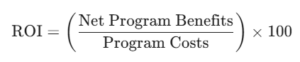
As an example, let’s look at a hypothetical Coveros “Fundamentals of AI” course delivered virtually to a team of 20 Software Test Engineers. To calculate ROI using the Phillips Methodology, we need to move beyond “Did the students like the class?” and into hard data, which will require collection of metrics as we will see:
The 5-Level ROI Calculation
- Reaction
- Data: Post-course surveys show a 4.8/5 satisfaction rating.
- Insight: The engineers found the AI-assisted coding tools relevant to their daily development tasks.
- Learning
- Data: Pre- and post-assessment scores.
- Insight: Average scores rose from 45% to 85%. The team now understands how to use LLMs for unit test generation and code reviews.
- Application (Behavior)
- Data: Repository audits 3 months later.
- Insight: 90% of the team is actively using AI-assisted programming tools. There is a noticeable shift in how they create, document, and review code and handle common development tasks.
- Business Impact
There are any number of specific metrics you might use to measure business impact; some examples include performance metrics like Mean Time To Recovery, Change Failure Rate, Vulnerability Discovery Rate (Pre- vs. Post-Production), Pipeline Cycle Time / Lead Time for Changes, and Cloud (or other) Resource utilization or efficiency metrics. For our example we have chosen to focus primarily on Increased Velocity (Time Savings) as it is easily captured and readily converted to monetary value. The calculations are as follows:
- Time Saved: Engineers save an average of 4 hours per week on manual unit testing and coding tasks**.**
- Annual Savings per Engineer: 4 hours × 48 weeks = 192 hours/year.
- Total Team Savings: 192 hours × 20 engineers = 3,840 hours/year.
- Monetary Value: At a fully burdened rate of $100/hour, the total benefit is $384,000.
The Phillips “Isolation” Step:
- We must acknowledge that some improvement might be due to a new software release or internal process changes.
- We estimate that 80% of this improvement is directly attributable to the training.
- Adjusted Benefit: $384,000 * 0.80 = $307,200
- ROI Calculation
First, we must calculate the Total Costs:
- Course Fees: $16,640
- Staff Time (Salaries during training using same fully burdened rate of $100/hr): $32,000
- Admin/Coordination: $2,000
- Total Cost: $50,640
Using the Phillips formula: ROI = (Net Program Benefits / Program Costs) * 100
- Net Benefits: $307,200 (Adjusted Benefit) – $50,640 (Cost) = $256,560
- The ROI Calculation: ($256,560 / $50,640) * 100 = 506.6%
Final Reporting ROI of Fundamentals of AI training for 20 engineers:
While the 507% ROI is the “headline” for the CFO, Phillips would also report intangible benefits including:
- Improved Employee Morale: Engineers feel more “future-proofed.”
- Reduced Burnout: Less time spent on tedious, repetitive coding tasks.
- Brand Authority: The enterprise is now seen as an AI-forward organization that will both see the benefits of AI-assisted productivity and will attract top talent to support its growth
Conclusion
The math is clear: training is not a “nice-to-have” or a line item to be slashed when budgets get tight. It is a high-yield financial instrument. When you look at a 507% ROI, you aren’t just looking at a successful class; you’re looking at a transformed balance sheet.
By shifting the perspective from the cost of training to the cost of stagnation, the decision becomes simple. Choosing not to train your team doesn’t save money – it accumulates “talent debt” that eventually demands payment in the form of high turnover, expensive recruitment cycles, and a loss of market agility.
In the technology sector, your only real moat is the collective intelligence and skills of your team. You can either pay a premium to “rent” abilities from the outside market, or you can build it from within, creating a culture of loyalty and peak performance that competitors cannot simply buy.
Stop Guessing. Start Growing.
Ready to turn your team into a high-return asset? Don’t let your “institutional DNA” walk out the door for a lack of growth opportunities.
- Contact our team today for a Training Needs Assessment. We’ll help you identify the skill gaps in your organization and build a roadmap to achieve measurable, high-impact ROI.
-or-
- Explore our Fundamentals of AI and Software Test Engineering courses to see how we can help your team achieve the same 500%+ ROI seen in our methodology.